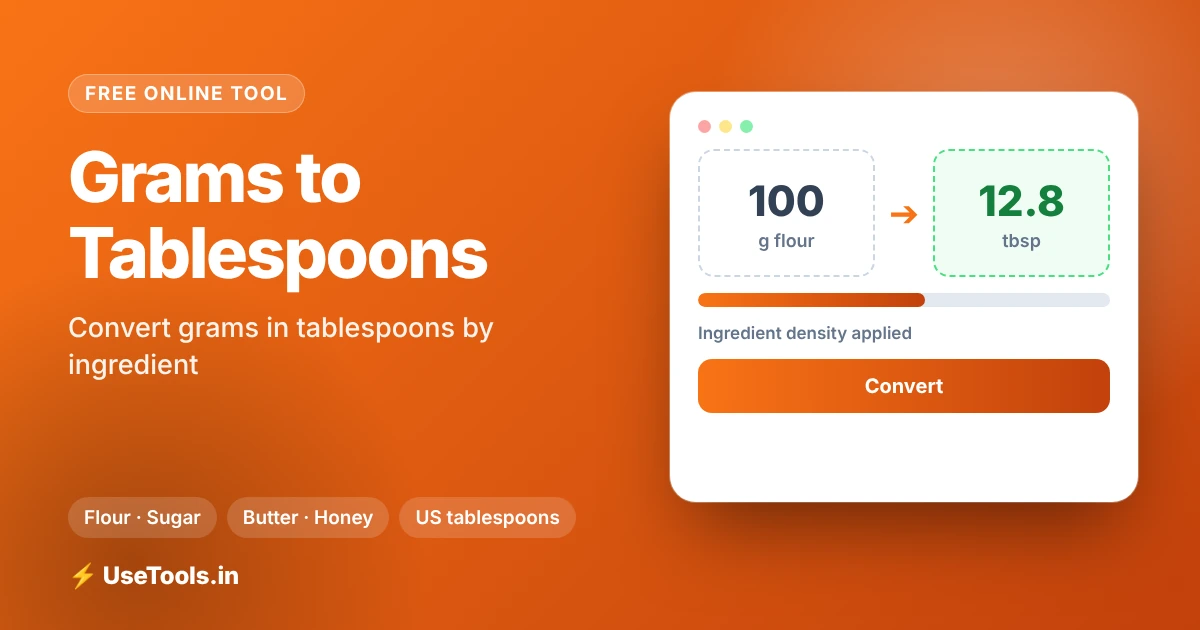
To convert grams in tablespoons, you divide the weight in grams by the weight of one tablespoon of that ingredient. Because flour, sugar, butter and honey all have different densities, there is no single answer. This free grams to tablespoons converter lets you pick the ingredient, enter the grams and see the US tablespoons instantly, with a chart for common amounts.
Why There Is No Single Grams to Tablespoons Number
Grams measure weight, while tablespoons measure volume. Ten grams of water takes up much more room than ten grams of honey, and ten grams of fluffy flour takes up even more than that. A tablespoon of water weighs about 14.8 g, a tablespoon of all-purpose flour about 7.8 g and a tablespoon of honey about 21 g. So the correct way to convert grams to tbsp is always by ingredient.
How to Convert Grams to Tablespoons
The formula is simple:
Tablespoons = grams ÷ grams per tablespoon
- Choose your ingredient from the list, grouped as flour and baking, sugars, fats and oils, dairy and other ingredients.
- Type the amount in grams.
- Read the result in US tablespoons. The chart below the tool updates to show common amounts for that ingredient.
Example: a recipe asks for 100 g of all-purpose flour. One tablespoon is about 7.8 g, so 100 ÷ 7.8 ≈ 12.8 tablespoons. For 100 g of granulated sugar at 12.5 g per tablespoon, the answer is exactly 8 tablespoons.
Grams per Tablespoon: Quick Reference
| Ingredient | Grams in 1 tbsp | Tbsp in 100 g |
|---|---|---|
| All-purpose flour | 7.8 g | 12.8 |
| Granulated sugar | 12.5 g | 8.0 |
| Brown sugar (packed) | 13.8 g | 7.2 |
| Powdered sugar | 7.5 g | 13.3 |
| Butter | 14.2 g | 7.0 |
| Vegetable oil | 13.6 g | 7.4 |
| Honey | 21 g | 4.8 |
| Milk | 15.3 g | 6.5 |
| Water | 14.8 g | 6.8 |
| Cocoa powder | 5.2 g | 19.2 |
| Table salt | 18 g | 5.6 |
These are typical values used by the converter. Real weights vary a little with brand, humidity and how firmly an ingredient is packed.
Ingredients You Can Convert
- Flour and baking: all-purpose, bread, cake and whole wheat flour, almond flour, cornmeal, cornstarch, baking powder, baking soda and yeast.
- Sugars and sweeteners: granulated, brown and powdered sugar, honey, maple syrup, molasses, corn syrup and jam.
- Fats and oils: butter, margarine, ghee, coconut oil, lard, olive oil and vegetable oil.
- Dairy: milk, heavy cream, sour cream, cream cheese and plain yogurt.
- Other: water, cocoa powder, chocolate chips, peanut butter, tahini, mayonnaise, oats, rice, salt, cinnamon, coffee, chia seeds, vanilla extract and gelatin.
Common Recipe Conversions Worked Out
Here are a few real examples you can check against the tool. 50 g of butter at 14.2 g per tablespoon is about 3.5 tablespoons, which is why a standard stick of butter is often described as 8 tablespoons. 50 g of ghee at 13.6 g per tablespoon is about 3.7 tablespoons. 250 g of granulated sugar equals 20 tablespoons. 30 g of cocoa powder at 5.2 g per tablespoon is roughly 5.8 tablespoons, a good reminder that light, fluffy powders take up far more space than their weight suggests. 20 g of honey is just under one tablespoon, because honey is dense.
How to Scale a Recipe Using Grams and Spoons
When you double or halve a recipe, convert first, then scale. Suppose a cookie recipe uses 200 g of flour and 100 g of sugar for twelve cookies and you want eighteen. Multiply each weight by 1.5 to get 300 g of flour and 150 g of sugar, then convert to tablespoons with the tool if you do not own a scale: about 38.5 tablespoons of flour and 12 tablespoons of sugar. At that size you can see why weighing is easier, but the conversion keeps you moving when a scale is not available. For very small amounts, such as under half a tablespoon, switch to teaspoons: one tablespoon equals three teaspoons.
Not All Tablespoons Are the Same
This converter uses the US tablespoon, which is about 14.79 ml. A metric tablespoon used in many countries, including the UK and India for recipes, is 15 ml, which is very close. In Australia, a tablespoon is 20 ml, which is about one third larger. If your recipe comes from Australia, scale the result accordingly or use grams if possible. A kitchen spoon from a cutlery set is also not a true measure, so use proper measuring spoons for baking.
Why Bakers Prefer Grams
Professional bakers weigh ingredients because weight is consistent while volume is not. A tablespoon of flour can differ by several grams depending on whether it was spooned lightly or scooped and packed. For cakes, bread and pastry, where ratios matter, a digital scale gives far more repeatable results. Use this tool when your recipe is in grams and you only have measuring spoons, or the other way around, and weigh whenever accuracy matters.
Tips for Accurate Spoon Measurements
- Spoon flour lightly into the measure and level it off with a knife. Do not scoop directly from the bag.
- Pack brown sugar firmly, as the ingredient list assumes it is packed.
- For sticky ingredients like honey, lightly oil the spoon so the full amount slides out.
- Treat small quantities, such as salt or baking powder, carefully because errors are magnified.
- When scaling a recipe, convert every ingredient, not just one, to keep the balance.
Other Handy Kitchen and Home Calculators
If you are planning a kitchen renovation as well as a recipe, our Square Footage Calculator can help you measure the floor or countertop area. For recipe blogs, make sure your photos load quickly by compressing them with the Image Convert MB to KB tool.
Grams to Tablespoons FAQs
How do I convert grams in tablespoons?
Divide the weight in grams by the weight of one tablespoon of that ingredient. For example, 100 g of flour at 7.8 g per tablespoon is about 12.8 tablespoons.
How many tablespoons is 100 grams?
It depends on the ingredient: about 12.8 tablespoons of all-purpose flour, 8 of granulated sugar, 7 of butter or 4.8 of honey.
Why do different ingredients give different results?
Each ingredient has a different density, so the same volume weighs a different amount.
Is a tablespoon the same everywhere?
No. A US tablespoon is about 14.79 ml, a metric tablespoon is 15 ml and an Australian tablespoon is 20 ml.
Are the results exact?
They are close estimates based on typical densities. Brand, humidity and packing can change the real weight slightly.
Is the converter free?
Yes. It is free to use and needs no sign-up.