The 1/3 negative marking calculator shows your net score when each wrong answer costs one third of the question’s marks. Enter total questions, maximum marks, attempts and wrong answers, and the tool returns your net score, accuracy and break-even accuracy. If you searched for a 1 3 negative marking calculator, this is the one. It is free and built for UPSC, RRB and state PSC aspirants.
What Does 1/3 Negative Marking Mean?
Under 1/3 negative marking, one third of a question’s marks is deducted for each wrong answer. Right answers earn full marks and blanks earn nothing. Because the penalty is a fraction, the deduction depends on the marks per question:
| Marks per correct answer | Deduction per wrong answer |
|---|---|
| 1 | 0.33 |
| 2 | 0.67 |
| 2.5 | 0.83 |
| 3 | 1 |
| 4 | 1.33 |
On a 2-mark question the penalty is about 0.67, which is why people sometimes quote it as two-thirds of a mark rather than one third.
Exams That Commonly Use 1/3 Marking
- UPSC prelims: One third of the question’s marks is deducted for each wrong answer, in both GS Paper 1 and CSAT.
- RRB exams: Papers such as NTPC and Group D commonly deduct one third of a mark on a one-mark question.
- State PSC prelims: Many commissions follow 1/3, but the rule varies, so check each notification.
- Defence entrance papers: Several papers use a one-third penalty. Verify the marks per question.
Important: Marking schemes change between exams, years and stages. Always confirm the exact penalty in your official notification.
How to Use the 1/3 Negative Marking Calculator
- The ratio is already set to 1/3. You can also tap UPSC, RRB or State PSC.
- Enter Total Questions and Maximum Marks. A 100-question paper of 1 mark each is 100 and 100.
- Enter Questions Attempted and Wrong Answers.
- Press Calculate my score to see the net score and accuracy gauge.
- Download the PDF or share the result after each mock test.
1/3 Negative Marking Formula and Examples
- Net score = (Correct × Marks per correct) − (Wrong × Marks per correct × 1/3)
- Correct answers = Attempted − Wrong
- Accuracy = Correct ÷ Attempted × 100
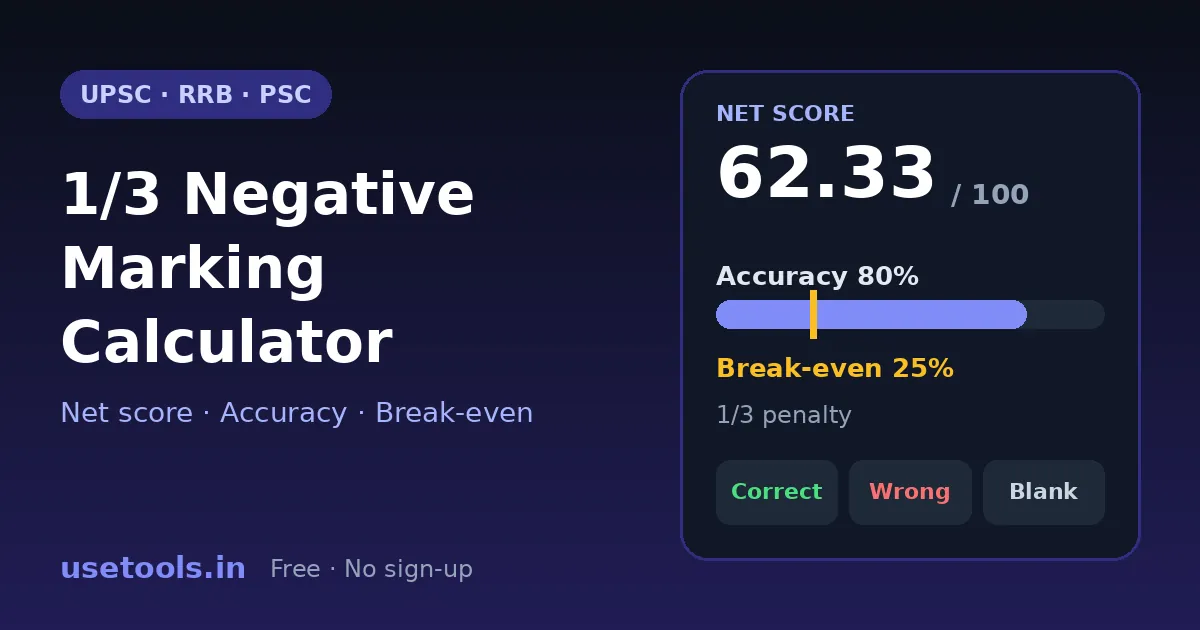
Example 1 (RRB style): 100 questions, 100 marks. You attempt 85 and 17 are wrong. Correct = 68, so net score = 68 − 5.67 = 62.33 out of 100. Accuracy is 80%.
Example 2 (2-mark paper): 100 questions, 200 marks. You attempt 80 and 20 are wrong. Correct = 60, so net score = 120 − 13.33 = 106.67 out of 200. Accuracy is 75%.
The 25% Break-Even Accuracy Under 1/3 Marking
Break-even accuracy is 0.333 ÷ 1.333 = 25%. Three wrong answers cancel the gain from one correct answer. On a four-option question, a blind guess has exactly a 25% chance, so its average return is zero. Any real knowledge, such as eliminating one or two options, moves the odds in your favour.
Here is what your accuracy means for 100 one-mark attempts under 1/3 marking:
| Accuracy | Correct | Wrong | Net score |
|---|---|---|---|
| 25% | 25 | 75 | 0 |
| 40% | 40 | 60 | 20 |
| 50% | 50 | 50 | 33.33 |
| 60% | 60 | 40 | 46.67 |
| 70% | 70 | 30 | 60 |
| 80% | 80 | 20 | 73.33 |
| 90% | 90 | 10 | 86.67 |
Each time you turn a wrong answer into a correct one, the net score rises by 1.33 marks on a one-mark paper, so accuracy gains are worth more here than under a lighter penalty.
1/3 vs 1/4 Negative Marking
The heavier the penalty, the higher your accuracy must be before a guess pays off. Under 1/3 the break-even point is 25%, while under 1/4 negative marking it is 20%. For the same 100 attempts at 60% accuracy, a one-mark paper gives 46.67 under 1/3 and 50 under 1/4. The gap grows as your accuracy falls, so guess more carefully when the penalty is one third.
Raw Score vs Net Score Under 1/3 Marking
Suppose two students each answer 70 questions correctly in a 100-question, 100-mark paper. Student A attempts only 70 and gets none wrong, so the net score is 70. Student B attempts all 100 and gets 30 wrong, so the penalty is 10 and the net score is 60. The count of correct answers is identical, yet the results differ by 10 marks. Seeing that gap after every mock test shows you exactly how much your wrong answers cost.
Strategy for 1/3 Negative Marking Exams
- Attempt in rounds. Take sure answers first, then those you can cut down to two options.
- Avoid blind guesses. They have zero expected value and add risk.
- Track marks per attempt across mocks to see whether extra attempts help.
- Review every wrong answer and label it as a concept gap, careless mistake or bad guess.
- Use the verdict line. The calculator tells you how far you are above or below break-even.
Common Mistakes With 1/3 Marking
- Deducting 0.33 on every paper. That is right only for 1-mark questions. On a 2-mark question the deduction is 0.67.
- Counting blanks as wrong. Unattempted questions are neutral.
- Using the wrong ratio. Some exams use 1/4 or no penalty, so check the notification.
- Chasing accuracy only. 95% accuracy on 40 attempts can lose to 80% on 90 attempts.
1/3 Negative Marking Calculator FAQs
What does 1/3 negative marking mean?
For each wrong answer, one third of that question’s marks is deducted. On a 2-mark question that is about 0.67 marks.
How do I calculate marks with 1/3 negative marking?
Multiply correct answers by marks per question, then subtract wrong answers × marks per question × 1/3.
What is the break-even accuracy for 1/3 marking?
It is 25%. At that accuracy, attempting a question neither gains nor loses marks on average.
Which exams use 1/3 negative marking?
UPSC prelims and RRB exams commonly use it, along with several state PSC and defence papers. Always confirm the scheme in your official notification.
Is guessing worth it under 1/3 negative marking?
A completely blind guess on four options has zero expected return. Guessing becomes worthwhile when you can eliminate at least one option.
Do unattempted questions lose marks under 1/3 marking?
No. Unattempted questions score zero and are not penalised.