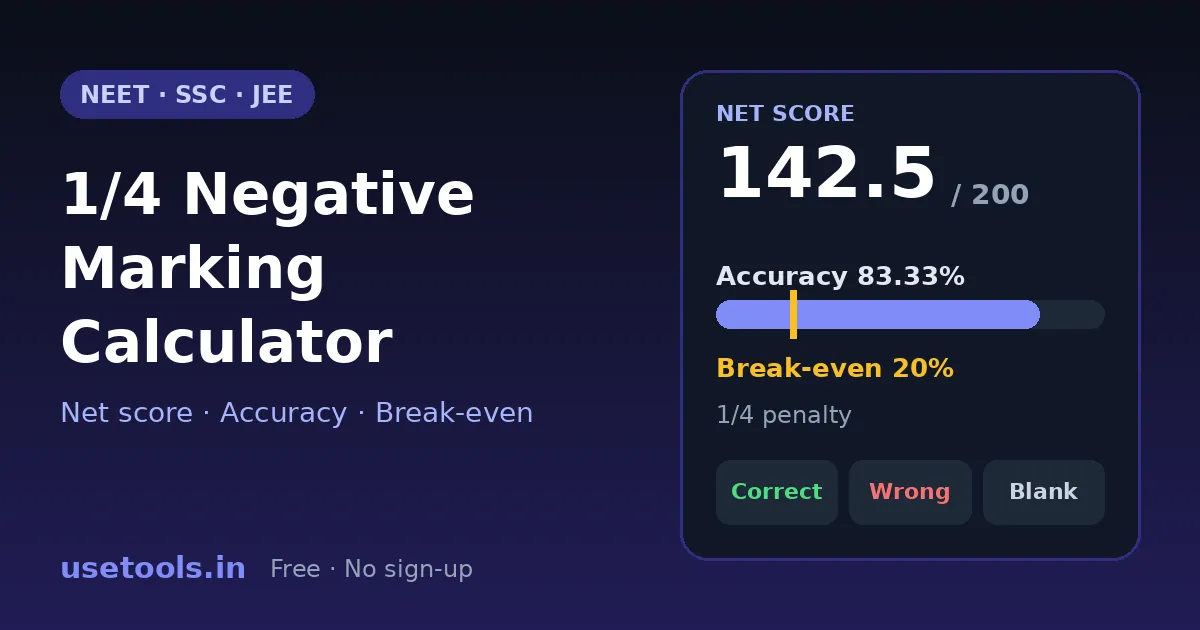
The 1/4 negative marking calculator shows your net score when each wrong answer costs one quarter of the question’s marks. Enter total questions, maximum marks, attempts and wrong answers, and the tool returns your net score, accuracy and break-even accuracy. If you searched for a 1 4 negative marking calculator, this is the one. It is free and made for NEET, SSC, JEE and banking aspirants.
What Does 1/4 Negative Marking Mean?
Under 1/4 negative marking, one quarter of a question’s marks is deducted for every wrong answer. Correct answers earn the full marks and unattempted questions score zero. The deduction therefore scales with the marks of the question:
| Marks per correct answer | Deduction per wrong answer |
|---|---|
| 1 | 0.25 |
| 2 | 0.5 |
| 2.5 | 0.63 |
| 3 | 0.75 |
| 4 | 1 |
This is why a +4 and −1 scheme and a +2 and −0.5 scheme are the same ratio, even though the numbers look different.
Exams That Commonly Use 1/4 Marking
- NEET: 4 marks for a correct answer and −1 for a wrong one.
- JEE Main: +4 and −1 for multiple-choice questions. Some question types, such as numerical value questions, may carry no penalty.
- SSC exams: Tier 1 papers commonly give 2 marks with a 0.5 deduction. Verify the scheme for each exam.
- Banking prelims: Many bank exams deduct one fourth of a mark on a one-mark question.
Important: Schemes change from year to year and between stages. Confirm the exact marks and penalty in your official notification before relying on any result.
How to Use the 1/4 Negative Marking Calculator
- The ratio is already set to 1/4. You can also tap NEET, SSC, Banking or JEE.
- Enter Total Questions and Maximum Marks. A paper of 100 questions of 4 marks each is 100 and 400.
- Enter Questions Attempted and Wrong Answers.
- Press Calculate my score to see your net score and accuracy gauge.
- Download the PDF or share the result after every mock test.
1/4 Negative Marking Formula and Examples
- Net score = (Correct × Marks per correct) − (Wrong × Marks per correct × 1/4)
- Correct answers = Attempted − Wrong
- Accuracy = Correct ÷ Attempted × 100
Example 1 (SSC style): 100 questions, 200 marks. You attempt 90 and 15 are wrong. Correct = 75, so net score = 150 − 7.5 = 142.5 out of 200. Accuracy is 83.33%.
Example 2 (4-mark paper): 90 questions, 360 marks. You attempt 72 and 18 are wrong. Correct = 54, so net score = 216 − 18 = 198 out of 360. Accuracy is 75%.
The 20% Break-Even Accuracy Under 1/4 Marking
Break-even accuracy is 0.25 ÷ 1.25 = 20%. Four wrong answers cancel the gain from one correct answer. On a four-option question, a blind guess has a 25% chance, which is slightly above break-even, so the average return is a small positive 0.25 marks on a 4-mark question. The catch is variance: a run of bad guesses can still cost you several marks.
Here is what your accuracy means for 100 one-mark attempts under 1/4 marking:
| Accuracy | Correct | Wrong | Net score |
|---|---|---|---|
| 20% | 20 | 80 | 0 |
| 40% | 40 | 60 | 25 |
| 60% | 60 | 40 | 50 |
| 80% | 80 | 20 | 75 |
| 90% | 90 | 10 | 87.5 |
Each time you turn a wrong answer into a correct one, the net score rises by 1.25 marks on a one-mark paper, which shows how quickly accuracy improvements pay off.
Raw Score vs Net Score Under 1/4 Marking
Suppose two students each answer 70 questions correctly in a 100-question, 100-mark paper. Student A attempts only 70 and gets none wrong, so the net score is 70. Student B attempts all 100 and gets 30 wrong, so the penalty is 7.5 and the net score is 62.5. The count of correct answers is identical, yet the results differ by 7.5 marks. A calculator makes that gap visible after every test, which is the first step toward cutting avoidable errors.
Strategy for 1/4 Negative Marking Exams
- Answer sure questions first, then medium ones, and leave risky guesses for the end.
- Eliminate options. Removing even one option lifts your chance well above 20%.
- Watch marks per attempt. If it falls as attempts rise, your extra guesses are not paying off.
- Sort your errors into concept gaps, careless mistakes and bad guesses, then fix each differently.
- Compare with 1/3. The penalty is lighter here than under 1/3 negative marking, so calculated risks are easier to justify.
Common Mistakes With 1/4 Marking
- Deducting 0.25 on every paper. That is right only for 1-mark questions. On a 4-mark question the deduction is 1.
- Counting blanks as wrong. Unattempted questions are neutral.
- Ignoring question types. Some sections may have no negative marking, so calculate them separately.
- Looking at accuracy alone. A high accuracy on very few attempts can still give a low net score.
1/4 Negative Marking Calculator FAQs
What does 1/4 negative marking mean?
For each wrong answer, one quarter of that question’s marks is deducted. On a 4-mark question you lose 1 mark, and on a 2-mark question you lose 0.5.
How do I calculate marks with 1/4 negative marking?
Multiply correct answers by marks per question, then subtract wrong answers × marks per question × 0.25.
What is the break-even accuracy for 1/4 marking?
It is 20%. At that accuracy, attempting a question neither gains nor loses marks on average.
Is NEET negative marking 1/4?
NEET gives 4 marks for a correct answer and deducts 1 mark for a wrong one, which is 1/4 of the question’s marks. Confirm the scheme in the latest official notification.
Can I use this calculator for SSC, JEE and banking exams?
Yes. Select the matching chip or keep the 1/4 ratio, enter the paper totals and verify the exact scheme in your notification.
Do unattempted questions lose marks under 1/4 marking?
No. Unattempted questions score zero and are not penalised.