The UPSC negative marking calculator turns your prelims attempt into a real net score. Enter total questions, maximum marks, questions attempted and wrong answers. The tool applies the standard one-third penalty and returns your net score, accuracy and break-even accuracy in seconds. It is free, needs no sign-up and works for both GS Paper 1 and CSAT.
How UPSC Prelims Negative Marking Works
The UPSC Civil Services Preliminary Examination is fully objective, and wrong answers are penalised. For every incorrect answer, one third of the marks allotted to that question is deducted. A question you leave blank earns nothing and loses nothing. As per the official notification, marking more than one option is treated as a wrong answer even if one of the options is correct, and the same penalty applies.
Because the penalty is a fraction of each question’s marks, the deduction depends on how many marks the paper gives per question. Based on the recent pattern, the two prelims papers work like this:
| Paper | Questions | Max marks | Marks per correct | Penalty per wrong |
|---|---|---|---|---|
| GS Paper 1 | 100 | 200 | 2 | 0.67 |
| CSAT (Paper 2) | 80 | 200 | 2.5 | 0.83 |
CSAT is a qualifying paper with a 33% threshold, while GS Paper 1 decides who moves on to the mains. Paper patterns can change, so always verify the numbers in the latest notification on the official UPSC website.
How to Use the UPSC Negative Marking Calculator
- The UPSC preset is already selected, so the ratio is set to 1/3.
- For GS Paper 1, enter 100 as Total Questions and 200 as Maximum Marks. For CSAT, enter 80 and 200.
- Enter the number of questions you attempted and how many of them were wrong.
- Press Calculate my score to see your net score, accuracy, marks per attempt and the gauge.
- Download the result as a PDF or share it with your study group after each mock test.
Tip: Count wrong answers from the official or test-series answer key, not from memory. Also note how many of your correct answers were pure guesses, because that tells you how risky your attempt really was.
UPSC Prelims Score Formula
The calculator uses the same arithmetic you would use on paper:
- Marks per correct answer = Maximum Marks ÷ Total Questions
- Correct answers = Attempted − Wrong
- Penalty per wrong answer = Marks per correct × 1/3
- Net score = (Correct × Marks per correct) − (Wrong × Penalty per wrong)
- Accuracy = Correct ÷ Attempted × 100
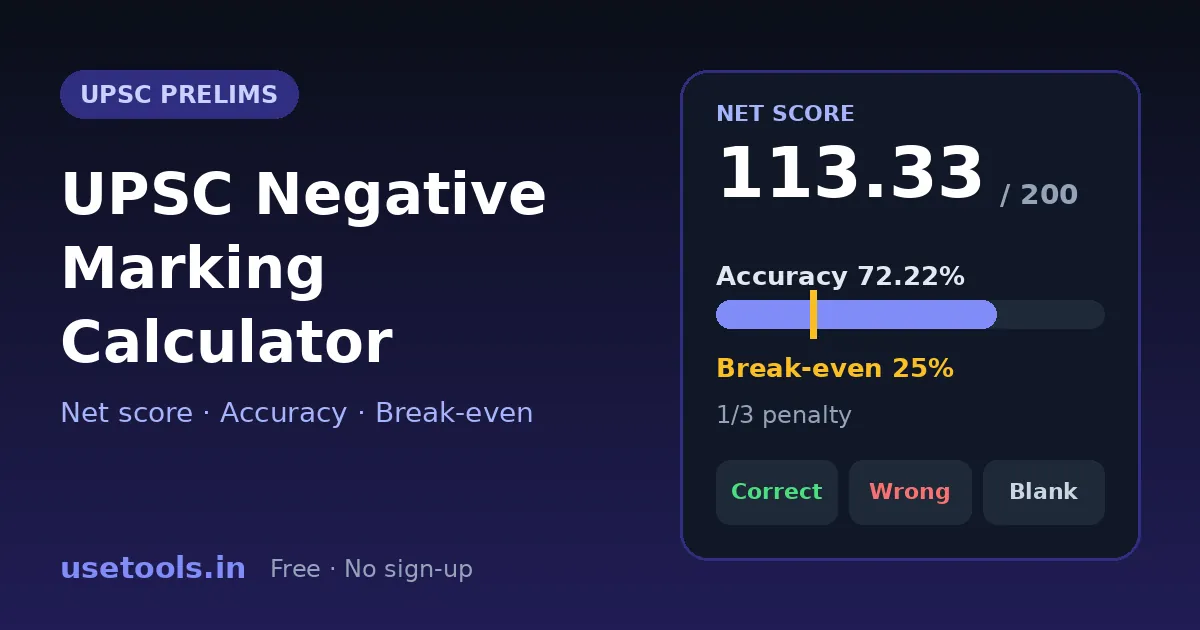
Worked example (GS Paper 1): You attempt 90 questions and 25 are wrong. Correct = 65. Each question is worth 2 marks and each wrong answer costs 0.67, so net score = 130 − 16.67 = 113.33 out of 200. Accuracy is 72.22%.
Now compare a more careful attempt. With 70 questions attempted and only 10 wrong, correct answers are 60 and the net score is 120 − 6.67 = 113.33 again. Twenty fewer attempts gave the same result, which shows why accuracy can matter as much as the number of attempts.
Break-Even Accuracy for UPSC: The 25% Rule
With a one-third penalty, break-even accuracy is 0.333 ÷ 1.333 = 25%. At that accuracy a guess neither adds nor removes marks on average. Put differently, three wrong answers (3 × 0.67 = 2 marks) cancel the gain from one correct answer.
This is why elimination is so valuable. If you can remove two of the four options, your chance rises to 50% and the expected return on that question is (0.5 × 2) − (0.5 × 0.67) = 0.67 marks. If you have no clue and every option looks equally likely, the chance is exactly 25% and the expected gain is zero, so the decision depends on how much risk you can handle.
How to Plan Your Attempts in UPSC Prelims
- Attempt in rounds. Mark sure answers first, then questions you can narrow to two options, and leave pure guesses for last.
- Know your accuracy by subject. If your polity accuracy is 85% and your economy accuracy is 55%, be bolder in the first.
- Set a personal floor. If your accuracy on doubtful questions stays close to 25% in recent mocks, leave those questions blank.
- Read the verdict line. When accuracy falls below break-even, the calculator warns that guessing is costing you marks.
- Keep the cut-off in perspective. The cut-off changes every year, so compare your net score with previous official cut-offs instead of chasing one fixed number.
Using the Calculator After Every UPSC Mock Test
Log four numbers after every mock: attempts, wrong answers, accuracy and net score. Over five or six tests you will see whether your attempts are rising faster than your accuracy. If both climb together, your preparation is working. If attempts rise but accuracy drops, the extra questions are costing you marks and the marks per attempt figure will fall as well.
Calculate GS Paper 1 and CSAT separately, because their marks per question and penalties differ. Mock results also vary between test series, so compare yourself with your own trend rather than with another student’s score.
Common Mistakes in UPSC Negative Marking Calculations
- Deducting 0.33 per wrong answer. That is right only for a one-mark paper. In GS Paper 1 the penalty is 0.67.
- Counting blanks as wrong. Unattempted questions are neutral.
- Mixing GS Paper 1 and CSAT. They have different question counts and marks per question.
- Forgetting double marking. Two bubbles on the OMR sheet count as a wrong answer.
- Judging by attempts alone. A high attempt count with low accuracy can score less than a careful attempt.
UPSC Negative Marking Calculator FAQs
How is negative marking calculated in UPSC prelims?
Each wrong answer costs one third of the question’s marks. In GS Paper 1 a question is worth 2 marks, so a wrong answer deducts about 0.67 marks.
What is the negative marking in UPSC CSAT?
CSAT also uses a one-third penalty. With 80 questions for 200 marks, each question is worth 2.5 marks and a wrong answer costs about 0.83 marks.
Is there negative marking for unattempted questions in UPSC?
No. Unattempted questions score zero and are not penalised. Only wrong answers lose marks.
What accuracy is safe for attempting a UPSC question?
Break-even accuracy is 25%. Any question you are more than 25% sure about has a positive expected return, which is why narrowing to two options usually makes a guess worthwhile.
Can I use this calculator for coaching mock tests?
Yes. Enter the mock’s total questions and maximum marks, keep the 1/3 ratio and confirm the scheme in your test series instructions.
Does this calculator predict my UPSC cut-off?
No. It calculates your net score only. Cut-offs change every year, so compare your score with the official cut-offs of previous years.